Minimally Invasive Flat Foot Surgery London | Foot & Ankle Centre
Minimally invasive flat foot surgery using a sinus tarsi implant can help selected patients with painful flexible flat feet. Learn how subtalar arthroereisis works, who may be suitable and what recovery can involve.
Minimally Invasive Flat Foot Surgery: A Modern Treatment for Flexible Flat Feet
If you have spent years living with painful flat feet, you may already have tried treatments such as custom orthotics, physiotherapy, supportive footwear, exercises and anti-inflammatory medication.
For many people, these treatments successfully manage their symptoms. However, when persistent flat foot pain continues despite conservative treatment, surgery may be considered.
Traditional flat foot reconstruction can involve osteotomies, tendon procedures or joint fusion depending on the severity and underlying cause of the deformity. Understandably, the prospect of major reconstructive surgery and a lengthy recovery can feel daunting.
For carefully selected patients, however, there may be a less invasive alternative.
Minimally invasive flat foot surgery using a sinus tarsi implant, medically known as subtalar arthroereisis, is designed to control excessive movement within the foot and help improve alignment in people with certain types of flexible flat foot.
At the Foot & Ankle Centre, patients with painful flat feet can be assessed to determine the cause of their symptoms and whether minimally invasive treatment may be appropriate.
What Is Minimally Invasive Flat Foot Surgery?
One form of minimally invasive flat foot surgery is subtalar arthroereisis, sometimes referred to as sinus tarsi implant surgery.
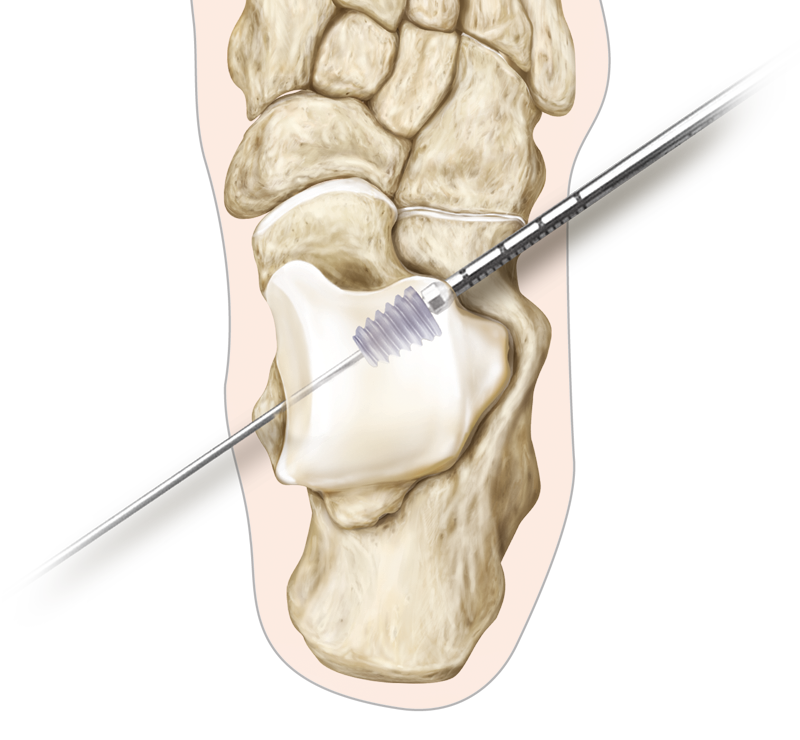
The procedure involves placing a small implant into a naturally occurring space on the outside of the foot called the sinus tarsi.
The sinus tarsi sits between two important bones:
- The talus, which forms part of the ankle
- The calcaneus, or heel bone
In a flexible flat foot, excessive movement through the subtalar joint can allow the foot to roll inwards excessively when standing and walking.
A sinus tarsi implant is designed to limit this excessive movement while still allowing normal motion of the foot.
The objective is to improve the alignment and mechanics of the foot, helping support the arch during weight-bearing.
What Is a Sinus Tarsi Implant?
A sinus tarsi implant is a small medical implant positioned within the sinus tarsi.
Different implant systems are available and can vary in their shape, size, material and design.
Unlike plates or screws used in some reconstructive operations, a sinus tarsi implant does not necessarily require the bones of the foot to be cut and repositioned.
Instead, the implant acts as a mechanical restraint, helping prevent excessive inward rolling or overpronation of the foot.
Because the procedure involves a relatively small incision and limited disruption of the surrounding tissues, it may offer a less invasive option than traditional flat foot reconstruction for appropriate patients.
What Is Subtalar Arthroereisis?
Subtalar arthroereisis is the medical name for the procedure used to place the sinus tarsi implant.
Its purpose is to restrict excessive movement through the subtalar joint while maintaining useful joint motion.
You may also see the procedure described online using terms including:
- Minimally invasive flat foot surgery
- Sinus tarsi implant surgery
- Sinus tarsi stent surgery
- Flat foot implant surgery
- Subtalar implant surgery
- HyProCure surgery
- Subtalar arthroereisis
Although these terms are sometimes used interchangeably, there are different implant systems and techniques available.
HyProCure and Sinus Tarsi Implants
HyProCure is one of the better-known implant systems associated with minimally invasive treatment for excessive foot pronation and flexible flat feet.
However, HyProCure is a particular implant system rather than the name of the surgical procedure itself.
The wider surgical technique is known as subtalar arthroereisis or sinus tarsi implant insertion.
Your surgeon will determine whether this type of treatment is appropriate for your individual foot structure and which surgical technique is most suitable.
Who Is Suitable for Minimally Invasive Flat Foot Surgery?
Patient selection is extremely important.
Subtalar arthroereisis is generally associated with flexible or mobile flat feet, rather than every form of flat foot.
A flexible flat foot typically becomes flatter when you stand but develops more of an arch when the foot is not bearing weight.
One simple indication of flexibility is whether your arch begins to reform when you stand on your tiptoes.
However, this is not a substitute for a proper clinical assessment.
Your surgeon may assess:
- The flexibility of your foot
- Your standing foot posture
- Your walking pattern
- Subtalar joint movement
- Achilles tendon flexibility
- Muscle and tendon function
- Areas of pain or tenderness
- X-rays or other imaging where required
Surgery would normally only be considered when symptoms are significant and appropriate non-surgical treatments have been unsuccessful.
What Is a Flexible Flat Foot?
A flexible flat foot is one where the arch changes depending on whether weight is being placed through the foot.
When standing, the arch may lower significantly and the heel may roll outwards.
When sitting, lifting the foot from the floor or standing on tiptoes, the arch may become visible again.
This ability to reposition the foot distinguishes a flexible flat foot from a more advanced rigid flat foot deformity.
Sinus tarsi implants are primarily designed to influence excessive movement, so the flexibility and overall structure of the foot are major considerations when deciding whether the procedure is suitable.
When Might a Sinus Tarsi Implant Not Be Suitable?
Not everybody with flat feet is suitable for minimally invasive implant surgery.
It may not be appropriate where there is significant:
- Rigid flat foot deformity
- Subtalar or midfoot arthritis
- Severe structural deformity
- Joint instability
- Advanced tendon dysfunction
- Other complex foot or ankle pathology
In these situations, a different form of flat foot reconstruction surgery may be more appropriate.
This could include tendon procedures, osteotomies to reposition bones or, in more advanced cases, joint fusion.
This is why an accurate diagnosis is essential before deciding on treatment.
What Happens During Sinus Tarsi Implant Surgery?
The procedure is performed through a relatively small incision on the outer side of the foot.
The surgeon accesses the sinus tarsi and assesses the appropriate implant size and position.
The implant is then positioned within the sinus tarsi to restrict excessive subtalar movement and improve the mechanical alignment of the foot.
The exact surgical technique and operating time vary depending on the patient and whether any additional procedures are required.
One of the potential advantages is that, in appropriate cases, the operation may avoid some of the extensive bone cutting associated with traditional reconstructive flat foot surgery.
Can Flat Foot Surgery Be Performed Without Cutting Bone?
In selected patients, yes.
One of the major reasons people investigate minimally invasive flat foot surgery is the possibility of correcting excessive foot movement without undergoing major bone reconstruction.
A standalone sinus tarsi implant procedure does not usually require the type of osteotomies used in conventional flat foot reconstruction.
However, some patients have additional deformities or problems that cannot be corrected by an implant alone.
Additional procedures may therefore still be recommended.
Can a Tight Achilles Tendon Cause Flat Feet?
A tight calf or Achilles tendon can contribute to abnormal foot mechanics and may be present alongside a flat foot deformity.
Your surgeon will therefore normally assess ankle movement and Achilles tendon flexibility during your examination.
In some patients, treatment of a tight gastrocnemius or Achilles tendon may be considered alongside correction of the flat foot.
If an additional procedure is performed, the recovery and weight-bearing instructions may be different from those for an isolated sinus tarsi implant.
Recovery After Minimally Invasive Flat Foot Surgery
Recovery after flat foot surgery varies considerably depending on the procedure performed and the individual patient.
Following an isolated sinus tarsi implant procedure, patients may typically require a period of protected walking using a surgical shoe, boot, splint or other support.
During the early stages of recovery, you may be advised to:
- Rest the foot
- Keep it elevated
- Reduce unnecessary walking
- Follow wound-care instructions
- Use the recommended protective footwear or boot
- Gradually increase activity under guidance
As healing progresses, patients can gradually return to supportive footwear and normal activities.
Return to running, sport and high-impact exercise will depend on healing, symptoms, strength and your surgeon's assessment.
If the sinus tarsi implant is combined with tendon surgery, Achilles tendon lengthening, osteotomy or another procedure, recovery may be considerably longer.
Your surgeon will give you a personalised recovery plan.
What Are the Benefits of Minimally Invasive Flat Foot Surgery?
For the right patient, potential advantages may include:
- A relatively small surgical incision
- Less disruption to bone and soft tissue than major reconstruction
- Correction of excessive pronation
- Improved foot alignment
- Improved walking mechanics
- Reduced symptoms associated with painful flexible flat feet
- Potentially faster recovery than more extensive reconstructive procedures
However, the best treatment should always be based on the underlying cause of the flat foot rather than simply choosing the procedure with the smallest incision.
What Are the Risks of a Sinus Tarsi Implant?
Like every operation, subtalar arthroereisis has potential complications.
One of the most commonly reported issues is pain around the sinus tarsi, where the implant is positioned.
Other possible complications can include:
- Persistent discomfort
- Implant irritation
- Incorrect implant positioning
- Over-correction or under-correction
- Infection
- Implant movement
- Ongoing symptoms
- Need for implant adjustment
- Need for implant removal
One advantage of this type of implant is that it can generally be removed if necessary.
The published evidence for subtalar arthroereisis in adults remains more limited than for many established reconstructive procedures, so the potential benefits and limitations should be discussed carefully with your surgeon.
Is Minimally Invasive Flat Foot Surgery Permanent?
The intention of surgery is to provide lasting improvement to the mechanics and symptoms of the foot.
However, a sinus tarsi implant is a physical implant and there are circumstances where it may subsequently need to be repositioned or removed.
Some patients tolerate their implant without significant problems, while others may develop discomfort around the sinus tarsi.
Your surgeon should discuss this possibility with you before surgery.
Is Flat Foot Surgery Worth It?
That depends on the cause of your flat feet, the severity of your symptoms and how much they interfere with your daily life.
Most people with flat feet do not require surgery.
However, if you have painful flexible flat feet that significantly affect walking, work, exercise or everyday activities and have not responded to conservative treatment, surgical treatment may be worth considering.
The important question is not simply whether you have flat feet, but why your feet are flat and which structures are causing your symptoms.
A specialist assessment can determine whether a minimally invasive procedure is suitable or whether another treatment would provide a better result.
Minimally Invasive Flat Foot Surgery in London
If you are searching for minimally invasive flat foot surgery in London, the first step should be a detailed assessment of your foot structure and walking mechanics.
At the Foot & Ankle Centre, we assess patients experiencing painful flat feet and other foot and ankle conditions to determine the underlying cause of their symptoms.
Depending on your diagnosis, treatment options may range from conservative management such as orthotics and rehabilitation through to minimally invasive flat foot surgery or more comprehensive reconstructive procedures.
The goal is not simply to create an arch, but to improve the function, alignment and comfort of the foot.
Book a Flat Foot Assessment
If flat feet are causing persistent pain, difficulty walking or preventing you from enjoying sport and everyday activities, a specialist assessment can help determine the most appropriate treatment.
At the Foot & Ankle Centre, we can assess your foot structure, flexibility and biomechanics and discuss whether minimally invasive flat foot surgery may be suitable for you.
Book a consultation with the Foot & Ankle Centre to discuss your flat foot treatment options.
Frequently Asked Questions About Flat Foot Surgery
What is the least invasive surgery for flat feet?
For selected patients with flexible flat feet, subtalar arthroereisis using a sinus tarsi implant may provide a less invasive option than traditional reconstruction involving osteotomies or joint fusion. It is not suitable for every type of flat foot.
Can flat feet be corrected without major surgery?
Some flexible flat foot deformities may be treated using a sinus tarsi implant without major bone reconstruction. Whether this is possible depends on the cause, flexibility and severity of the deformity.
What is a sinus tarsi implant?
A sinus tarsi implant is a small implant positioned within the sinus tarsi, a naturally occurring space between bones at the rear of the foot. It is designed to limit excessive subtalar joint movement.
What is subtalar arthroereisis?
Subtalar arthroereisis is a surgical procedure that uses an implant to restrict excessive movement of the subtalar joint. It is most commonly associated with treatment of flexible or mobile flat foot.
Is HyProCure the same as flat foot surgery?
HyProCure is a particular implant system used for subtalar stabilisation. The surgical technique itself is generally referred to as subtalar arthroereisis or sinus tarsi implant insertion.
How long does recovery from minimally invasive flat foot surgery take?
Recovery varies depending on the patient and whether any other procedures are performed at the same time. An isolated implant procedure may have a shorter recovery than extensive reconstructive surgery, while combined tendon or bone procedures can require substantially longer rehabilitation.
Can adults have sinus tarsi implant surgery?
Subtalar arthroereisis has been used in adults with symptomatic flexible flat feet, although adult flat foot deformity can be complex and the procedure is often used selectively or alongside other treatments.
Can the flat foot implant be removed?
Yes. A sinus tarsi implant can generally be removed if it causes persistent symptoms or another problem develops. Your surgeon should discuss the risks of implant irritation and possible removal before the operation. Book a Flat Foot Surgery Consultation
If painful flat feet are affecting your walking, work, exercise or everyday life, the first step is finding out exactly what is causing the problem and which treatment is right for you.
At the Foot & Ankle Centre, we assess and treat a wide range of foot and ankle conditions, including painful flexible flat feet. Following a detailed assessment of your foot structure, flexibility and biomechanics, we can discuss whether minimally invasive flat foot surgery may be suitable for you or whether another treatment would provide a better outcome.
If you would like to find out whether you are a suitable candidate, book a consultation with the Foot & Ankle Centre and speak to our team about your flat foot treatment options.